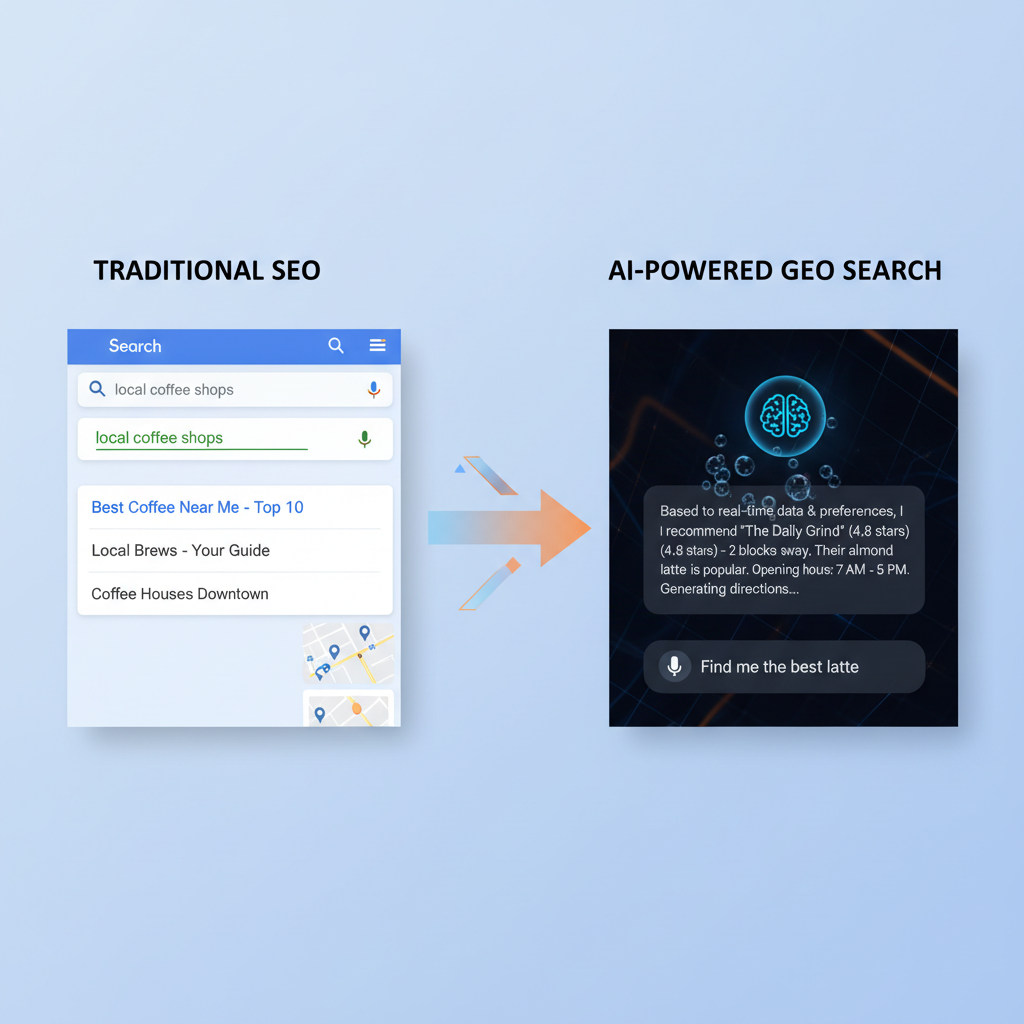
You've spent years (and real money) getting your business to rank on Google. That still matters. But there's a second game being played now — and most businesses don't even know they're losing it.
Traditional SEO: The Game You Already Know
Search Engine Optimization is the practice of getting your website to rank higher in Google (and Bing) results. It's been the backbone of digital marketing for over two decades, and it works by signaling to search engines that your content is relevant, authoritative, and trustworthy.
The core levers of traditional SEO:
Keywords — matching what people type into search bars. Backlinks — other sites linking to yours as a credibility signal. Technical health — fast load times, clean code, mobile-friendliness. On-page optimization — titles, meta descriptions, headers. Domain authority — your overall reputation built over time.
The goal: appear in the list of blue links when someone searches. The measure of success: ranking position and organic traffic.
GEO: The New Game in Town
Generative Engine Optimization (GEO) — also called LLM SEO or AEO (Answer Engine Optimization) — is the practice of getting your brand cited and recommended by AI tools like ChatGPT, Perplexity, Claude, and Google's AI Overviews.
Instead of a list of links, these tools generate a single synthesized answer. They don't rank your page — they either cite it or ignore it.
The core levers of GEO:
Answer-first content — directly addressing real questions in clear, self-contained chunks. Entity authority — being mentioned across credible third-party sources. Structured, machine-readable content — schema markup, clean HTML, logical hierarchy. Topical depth — covering a subject comprehensively, not just targeting a keyword. Original insights — data, case studies, or perspectives AI can't get elsewhere.
The goal: be the source AI models quote when your customers ask questions. The measure of success: citation frequency and share of AI voice.
Do You Need Both?
Yes — and here's the good news: they're not opposites. A well-structured, authoritative, useful website is the foundation of both. Where they diverge is in what you measure and how you think about content.
Traditional SEO is still worth doing. Google handles billions of searches daily and isn't going anywhere. But if you're only optimizing for Google, you're already invisible to a fast-growing slice of your potential customers — the ones who now start their search in an AI chat window.
The businesses winning in 2026 are optimizing for both. And the ones who get into GEO early — before their competitors even know it exists — are building an advantage that will compound.
Want to know how you're showing up in AI search right now?
We'll run your business through ChatGPT, Perplexity, and Claude and show you exactly what comes up (or doesn't). Free, no strings attached.