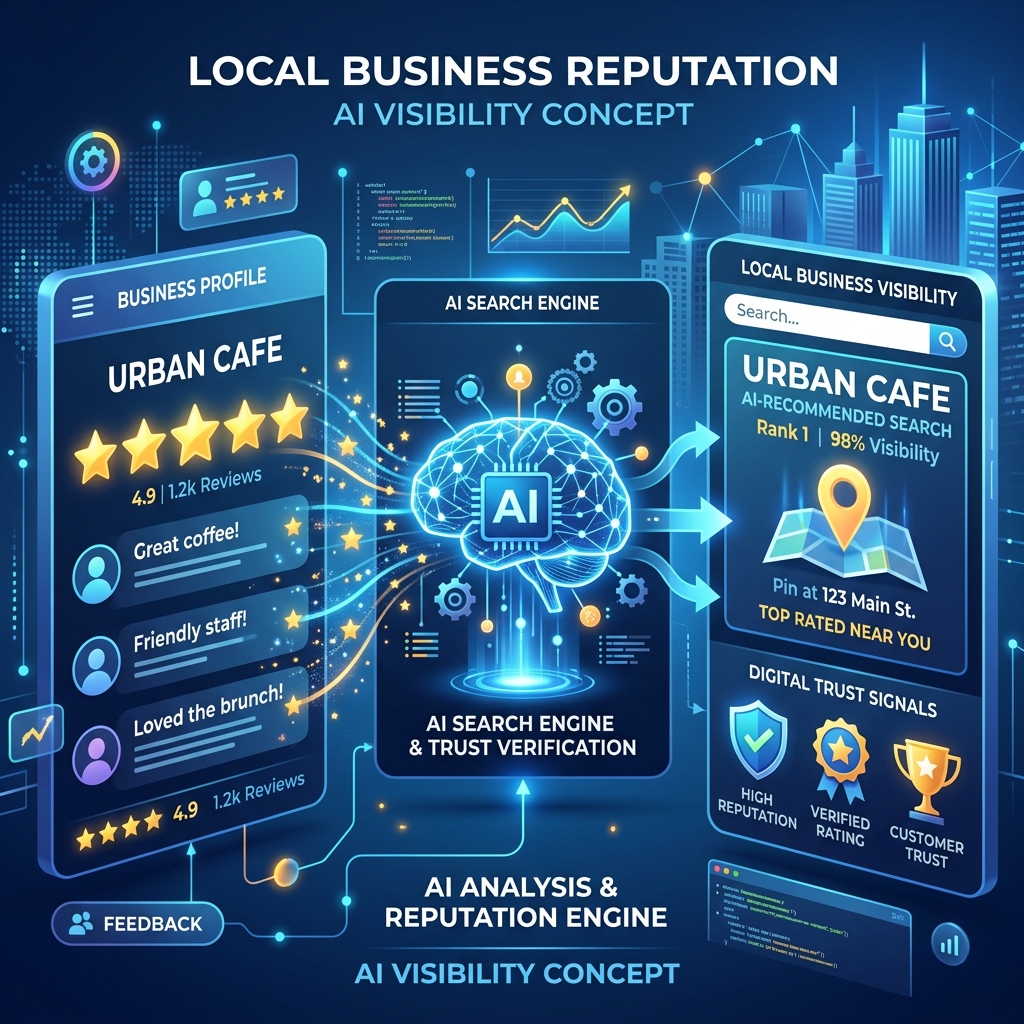
You already know reviews matter for Google. But here's what most business owners don't realize: AI tools like ChatGPT and Perplexity are reading your reviews too — and using them to decide whether to recommend you.
How AI Tools Actually Evaluate Local Businesses
When someone asks ChatGPT "what's the best plumber near me?" or Perplexity "which dentist in Austin has the best reviews?" — these tools don't just guess. They pull from a web of publicly available signals to construct their answer.
Those signals include your ratings across platforms, the language inside individual reviews, how recently reviews were posted, how consistently they appear, and whether the business engages with them. It's a richer picture than most people expect.
In short: your review profile has become part of your brand's AI footprint. A weak or neglected review presence sends the same signal to an AI model that it sends to a skeptical customer — and AI acts on it the same way.
It's Not Just the Star Rating
This is where it gets interesting. AI models don't just count stars — they read the actual text of your reviews.
A review that says "John fixed our AC in under two hours, showed up on time, and explained everything clearly" is rich with signals: service type, response time, professionalism, communication style. An AI processing that review learns what your business actually does and how well it does it.
Generic five-star reviews ("Great service!" "Highly recommend!") contribute almost nothing to your AI visibility. The depth, specificity, and recency of your review content matters far more than the volume alone.
The Platforms That Carry Weight
Not all review platforms are equal in the eyes of AI. Google Business Profile is the most heavily weighted — crawled constantly, trusted widely, and cited often. Yelp carries significant authority, particularly for home services, restaurants, and health businesses. Facebook reviews add to your overall entity footprint in local markets.
Beyond the big three, industry-specific platforms matter too. Healthgrades for medical practices, Avvo for legal, Houzz for contractors. These niche directories carry strong credibility signals within their categories — and AI knows the difference.
The broader and more consistent your presence across trusted platforms, the stronger your authority signal. AI tools are looking for corroboration — multiple sources saying the same good things about you.
What a Well-Optimized Review Profile Looks Like
Businesses that show up consistently in AI recommendations tend to share a few characteristics. Their reviews are detailed and describe real experiences. They're active across multiple relevant platforms. Their review volume grows steadily rather than spiking and stalling. And the business visibly engages — responding to feedback, good and bad, in a way that signals an attentive owner.
This isn't an accident. It's the result of a deliberate strategy — one that most local businesses haven't started yet, which means the window to get ahead of competitors is still wide open.
The Bottom Line
Reviews have always been about trust. What's changed is that machines are now reading them too — and those machines are increasingly the first stop in a customer's buying journey.
If your review profile isn't being actively managed with AI visibility in mind, you're likely being passed over in favor of competitors who are — even if your actual service is better. That's a fixable problem, but only if you know it exists.
Wondering how AI tools are describing your business right now?
That's exactly what we uncover in a free AI Visibility Audit. We run your business through ChatGPT, Perplexity, and Claude, show you what's coming up — and what's not — and map out what it would take to change it.